

Niloufar's biggest visa challenge wasn't proving she could do the PhD — it was proving a 35-year-old professional leaving Iran would actually come back. Utter Vision helped her build one argument where her reason to leave and her reason to return were the same fact.
Her Best Case for Leaving Was Also Her Case for Coming Back
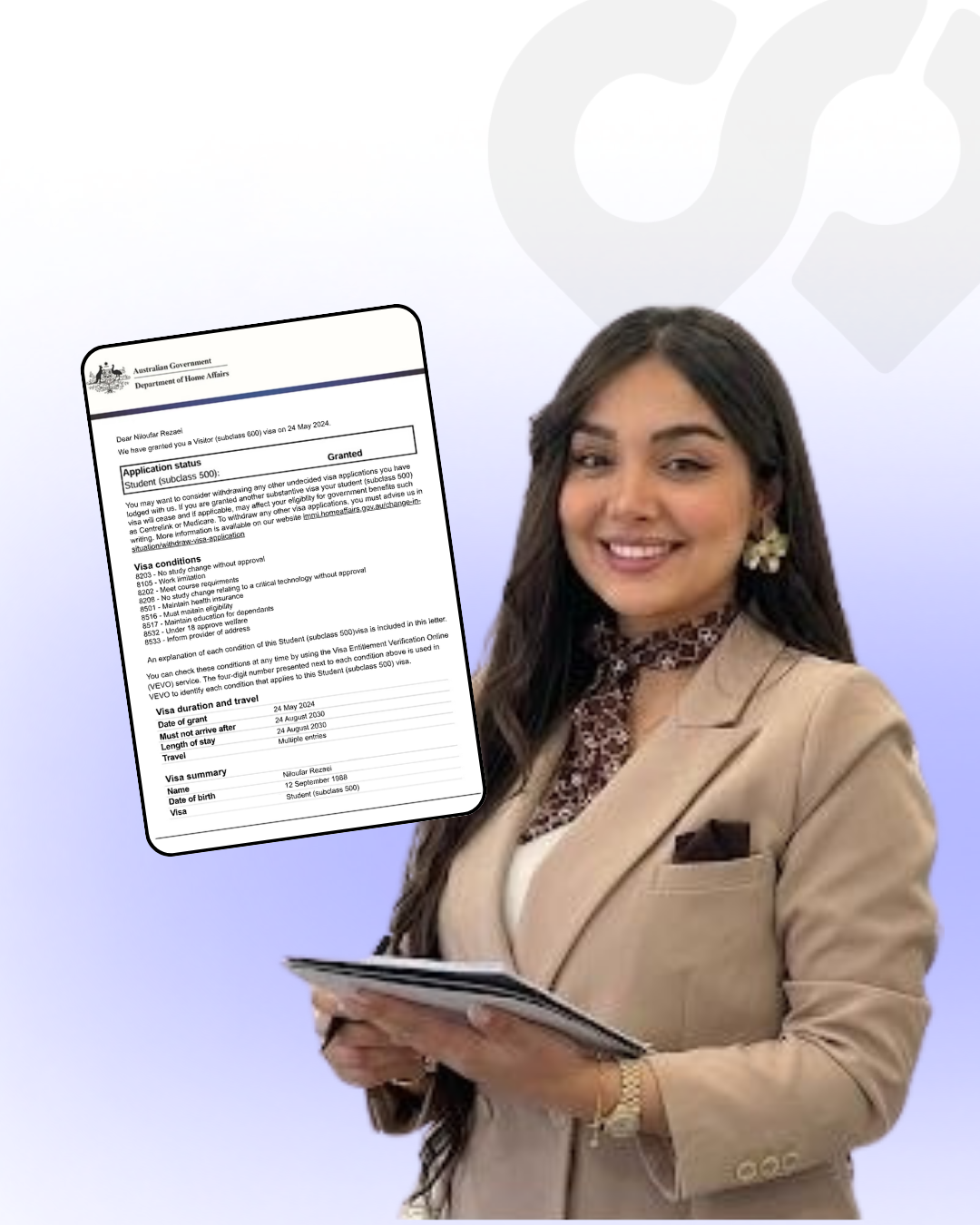
Niloufar Rezaei's Australian student visa was granted on May 24, 2024, on the strength of an argument that sounds backward until you actually hear it:
The best proof she'd come home was the exact reason she needed to leave.
Niloufar is 35, from Urmia, in Iran's West Azerbaijan province, where she grew up a short drive from a lake that used to be one of the largest saltwater lakes in the Middle East.
Over her lifetime, that lake had shrunk to a fraction of what it once was.
She remembers a childhood trip when her father drove them to a jetty that, by the time she was in university, sat nowhere near any actual water.
That memory stayed with her.
She studied civil engineering at a university in Tabriz, then spent about a decade working for a regional water authority. She watched well-intentioned restoration projects arrive too late or too small for a problem of that size.
Slowly, she came to a conclusion:
The problem wasn't a lack of effort. It was a lack of specialized expertise.
The Degree Wasn't an Escape Plan
Niloufar had been accepted into a PhD program at a university in Adelaide, specializing in water resource management, a field Australia is internationally known for given its long history of managing water across a dry continent.
Her husband, Hamid, an engineer himself, planned to stay in Tehran for the time being and join her later once her program settled into a rhythm.
Getting the offer had taken more than a year.
Niloufar emailed professors, refined her research proposal, revised it again, and kept going until one professor finally agreed to take her on.
The visa that followed required something different.
It wasn't asking whether she was academically capable. The university had already answered that question.
The harder question was whether a 35-year-old professional with a serious career, leaving Iran to pursue an advanced degree abroad, genuinely intended to return afterward.
That requirement, known in the Australian system at the time as the Genuine Temporary Entrant criterion, wasn't simply a checklist.
It was a judgment based on the application as a whole.
And Niloufar found it harder to write for than any technical document she'd produced during her career.
Simply saying she intended to return wasn't enough.
Her first draft, she admits, sounded like every other applicant's version of the same promise.
What she actually needed was one argument where leaving and returning were supported by the same facts.
Not two separate promises stapled together.
Lake Urmia Became the Center of the Story
Niloufar found Utter Vision while researching how other Iranian applicants had approached that particular part of the application.
She used its guidance to restructure what she'd already written.
Instead of describing her research interests in broad terms, she named Lake Urmiaspecifically.
Her proposed research focused on salinity modeling and restoration strategies, and she connected that work directly to projects already underway at her current employer.
The connection mattered.
Her research wasn't simply something interesting she wanted to study overseas.
It was training for work that already existed back home.
The degree wasn't framed as a way out of Iran.
It was framed as the missing piece of a project she was already in the middle of.
And at her current authority, nobody else had the specific training she needed to develop that work further.
Suddenly, the same fact that explained why she needed to leave also explained why she needed to return.
The Documents Told the Same Story
Alongside her statement, Niloufar gathered ordinary documentation that supported the same argument.
Her employer provided a letter confirming that her position would be held open for her return.
She provided proof of the apartment she and Hamid owned in Tehran.
She included her employment history, showing ten consistent years in the same field, rather than a recent career change that might suggest she was simply looking for a reason to leave.
None of this information was new.
But reorganized around one clear argument instead of scattered across different sections of the application, the documents stopped looking like a collection of loosely related facts.
Together, they looked like a plan.
May 24, 2024
Niloufar submitted her visa application in March 2024.
The Genuine Temporary Entrant statement had been rewritten around Lake Urmia specifically, rather than water management in the abstract.
The visa was granted on May 24, with no request for further information.
For Niloufar, the next chapter could finally begin.
Leaving Home Didn't Mean Leaving the Story Behind
She flew to Adelaide that July, in time for the program's mid-year intake.
The first few months were an adjustment.
The research culture expected far more independent initiative than she was used to, while the dry Australian climate had its own way of reminding her constantly of home.
Hamid visited for six weeks during that first year.
Since then, he has been slowly working out his own path to join her more permanently once her research reaches a stage where university facilities matter less than fieldwork back in Iran.
Niloufar is now well into her second year.
Part of last summer was spent collecting data that will eventually feed directly into the exact restoration models she described in her original application.
And her former employer has already agreed to fund a return position for her once she finishes.
The future she described in her visa application wasn't hypothetical. It was already waiting for her.
The Same Facts Told Both Sides of the Story
Niloufar says the visa application taught her something her engineering training never had to:
A good case isn't a longer list of facts.
It's the same facts arranged so clearly that a stranger can understand the whole picture.
Her career explained why she needed the degree.
The degree explained why she needed to leave.
Her research explained why the knowledge mattered back home.
And her career, employer, home, and planned work explained why she would return.
Leaving and coming back were never actually two different plans.
They were two parts of the same one.
 WhatsApp
 Twitter
 FaceBook
 Linkedin