

Majid paid a lawyer who left him refused and no wiser about why. A year later, Utter Vision's instructional videos taught him what actually goes into a visitor visa file — and this time, he understood every document before it was submitted.
He Paid a Lawyer for an Application He Never Got to See
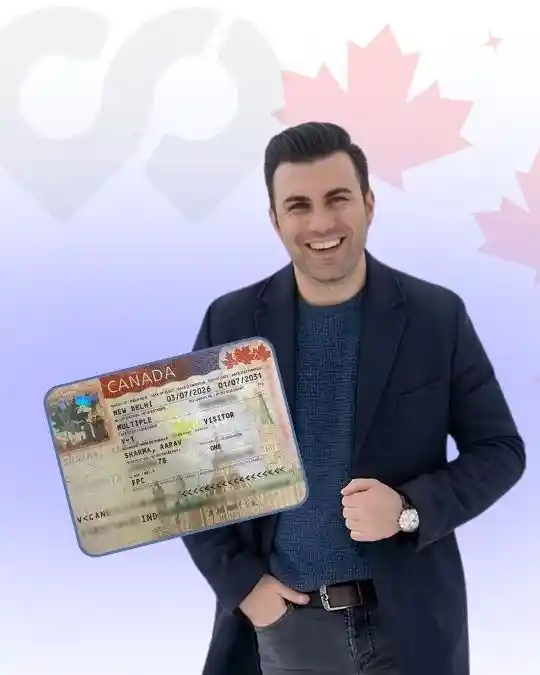
Majid Kanani's Canadian visitor visa was issued March 12, 2024, a year and change after a rejection he still can't fully explain, because nobody ever explained it to him.
Majid is 35, from Shiraz, Iran, where he owns a small pharmacy, he's run for about eight years, in the same neighborhood he grew up in. He's married to Neda, and they have two young children. His sister, Roya, has lived in Canada for several years now, in Calgary, where she works as a registered nurse. She got married there a couple of years ago, and she and her husband rent a house not far from the hospital where she works. Majid had never seen any of it in person — not the house, not the husband, not the life she describes in fragments over video calls that are always a little shorter than either of them wants.
About a year before his visa was issued, he hired a lawyer in Iran to handle a visitor visa application to go see her. He paid the fee, handed over the documents the lawyer asked for — his business license, some bank statements, a family registration booklet — and was told, more than once, that everything was in order.
The application was refused anyway, with the standard line about not being satisfied he'd leave Canada at the end of his stay. When Majid asked the lawyer what exactly had been weak in the file, or how the purpose of the trip had actually been described, the answers stayed vague.
Sometimes these things just happen, he was told. There wasn't much more to it than that, and no offer to look at what had actually been submitted together with him.
He didn't try again right away. Part of it was the cost of a second attempt on top of a first that hadn't worked. A bigger part of it was not knowing what he'd even be fixing the second time, since nobody had ever shown him the actual application itself, only asked him to sign where indicated and pay the balance.
Roya called most weeks and kept telling him to try again properly, sometimes attaching articles she'd found about the visa process that neither of them fully understood. Neda, more practically, kept asking why he'd paid someone a fee to end up knowing less about his own file than he had going into it.
Almost a year later, searching on his own late one night after the children were asleep, he came across Utter Vision.
The instructional videos did something the lawyer never had: they showed him, plainly, what an officer actually reads in a visitor visa file and why.
Not a checklist to copy blindly, but an explanation of the reasoning behind it — that a purpose-of-travel letter needs to say specifically who you're visiting, where, for how long, and why you're confident you'll be back, and that "ties" isn't a mysterious quality some people have and others don't, it's just whatever concretely connects a person to the life they're returning to.
He decided to apply himself this time.
Having already been rejected once, oddly, made the second attempt feel less frightening rather than more — the worst outcome had already happened to him once, through no clear fault he could even identify, so there wasn't much left to be afraid of in doing it properly this time and seeing what happened.
Working through Utter Vision's checklist over about two weeks of evenings, he rewrote the purpose-of-travel letter himself: Roya's full address in Calgary, the specific two-and-a-half weeks he intended to stay, built around her upcoming time off work, and a return date already tied to specific commitments at the pharmacy.
He gathered documents that actually showed the shape of his life in Shiraz rather than just stating it — his pharmacy's business registration and a recent tax filing, his professional pharmacist's license, which requires him to maintain continuous practice to keep, and a letter explaining that Neda and their children would remain in Iran for the full duration of the trip, with her own employment details included as well.
None of it was new information. It was simply the first time any of it had been assembled to actually explain something, instead of just filling space in a folder someone else had put together.
He applied through the visa centre in Ankara, since Canada has had no operating visa office inside Iran for years, making the trip there for biometrics in a single overnight stay he'd learned to plan for from other applicants' accounts online.
This time he understood every document in the package before it was submitted, because he'd been the one to decide what went into it and why.
The visa was issued March 12, 2024, with no further requests and no explanation needed, because this time the file had already explained itself.
Majid read the approval notice twice before calling his sister, mostly out of the same habit that made him read the refusal letter twice the year before, checking both times for a catch that turned out not to be there.
He flew to Calgary that spring and stayed just over two weeks, meeting his brother-in-law properly for the first time and sitting in Roya's kitchen most mornings while she got ready for a shift, the two of them talking the way they used to as kids before the day properly started.
Neda and the children stayed in Shiraz, and the pharmacy stayed open the entire time, run by the assistant pharmacist who normally covers for him during his usual holidays anyway.
He's back in Shiraz now, back at the pharmacy most days by eight. Roya is already talking about a longer visit next time, once her own schedule allows it, possibly with Neda and the children along, an idea Neda has started quietly researching on her own without waiting to be asked.
Majid says the difference between the two applications was never really about better documents.
It was that the second time, he actually understood what he was submitting and why, instead of paying someone else to understand it for him and simply hoping that had been enough.
 WhatsApp
 Twitter
 FaceBook
 Linkedin