

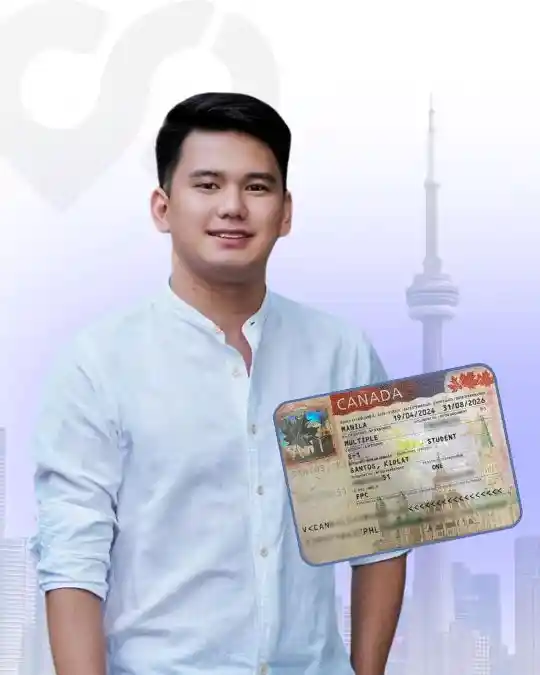
Kidlat's aunt in Winnipeg offered to fund his entire nursing bridging program — generous, but third-party sponsorship like that invites extra scrutiny. Utter Vision helped him build a study plan that stood on its own, funded by family but not dependent on her.
The Money Came From His Aunt in Canada. The Plan Still Had to Be His Own.
Kidlat Santos's Canadian study permit was issued August 19, 2024, on a file where the hardest thing to prove wasn't that the money was real.
It was that the plan belonged to him and not to whoever was paying for it.
Kidlat is 22, from Iloilo City, in the Western Visayas. He finished a nursing degree that spring at a local university, the same year most of his classmates did, and had never held a paying job of his own beyond a few months tutoring high schoolers in biology during his last semester to cover exam fees.
His father drives a tricycle around the same three barangays he's driven for twenty years; his mother runs a small sari-sari store out of the front room of their house, the kind that sells single cigarettes and phone load alongside canned goods.
The plan to study further in Canada existed mostly because of his aunt Marilou, his mother's older sister, a registered nurse who has lived and worked in Winnipeg for over fifteen years, ever since she left the Philippines through a recruitment program that brought over a whole cohort of Filipino nurses that same year.
She'd offered, the way aunts in that position often do, to cover his tuition and first year of living costs for a postgraduate bridging program that would help him toward eventual licensing as a nurse in Canada.
Kidlat had never been the one managing money at that scale before, and the offer, generous as it was, came with a specific problem neither of them fully appreciated until they started the actual application:
A study permit funded almost entirely by a relative already living in the destination country invites a particular kind of scrutiny.
A visa officer reading a file like that isn't just checking whether the money is real.
They're checking whether the whole plan is actually about studying.
Or whether the study permit is really just the first document in a longer, unstated plan to stay.
Neither Kidlat nor Marilou had done anything wrong, but the shape of the file, if put together carelessly, could read as exactly that kind of arrangement whether or not it was meant to be one.
Kidlat found Utter Vision while trying to work out how a sponsor from outside your own household was even supposed to be documented, since none of his classmates who'd applied elsewhere had used a setup quite like his.
Working through the portal's checklist over several video calls with Marilou on the other end, they put together a proper notarized sponsorship letter, her recent pay stubs and bank statements, a letter from her hospital confirming her employment, and documents establishing the actual family relationship between her and his mother.
Nothing exotic. Just the specific paperwork that makes a real relationship look like one on paper instead of an assumption a stranger has to take on faith.
The Other Half Had to Be His
The other half mattered just as much, and was entirely Kidlat's own to write:
A study plan that stood on its own, independent of his aunt's presence in Canada.
He described, specifically, the postgraduate bridging program he'd been accepted into, how it connected to work he wanted to eventually do at a public hospital back in Iloilo where nursing staff shortages were routine and had touched his own family directly during his grandmother's last illness.
He also named a cousin and both parents who remained in the Philippines as the life he intended to return to.
He rewrote the first draft twice, cutting a paragraph that leaned too heavily on how much he was looking forward to living near his aunt.
However true that was, it wasn't the reason the visa should be granted.
He filed the completed application in May 2024, with the funding clearly explained and his own plan standing apart from it rather than leaning on it.
The study permit was issued that August.
Then Came the Call
Marilou cried on the phone when he told her, which surprised him more than the approval itself did, since she'd been the calm, organized one throughout the entire process up to that point.
Kidlat flew to Winnipeg that September and moved in with her for his first few months, a temporary arrangement they'd both been upfront about in the application itself rather than leaving vague or unmentioned.
He's a couple of months into the program now, doing clinical placement hours alongside coursework at a hospital not far from his aunt's, and has started looking at shared apartments near campus for once the placement schedule settles down.
His parents call most Sundays, usually around the same time his mother is closing up the store for the evening.
She's taken to telling customers, unprompted, exactly which hospital in Canada her son is training near, whether or not they asked.
What the Application Really Needed
Kidlat says the file never really needed him to prove his aunt loved him, or that the money was legitimate.
Both of those were true and easy enough to show.
What it needed was something more important:
A plan that could stand up completely on its own, with or without her.
So that the file read as his own reason for going, funded by family, rather than a family arrangement that happened to require a study permit to work.
 WhatsApp
 Twitter
 FaceBook
 Linkedin